


Summary: Gemini 3.8 Flash is blindingly fast and features a 1M+ token context window. But when unleashed on large, complex codebases, speed without structure can lead to rewritten files, deleted features, and hallucinated dependencies. Here is how we turned Gemini 3.8 Flash into a surgically precise, senior pair programmer inside Google Antigravity using deterministic Tree-sitter AST knowledge graphs, lifecycle hooks, and behavioural guardrails.
⚡ The Gemini 3.8 Flash Dilemma: Incredible Speed, Dangerous Impulses
If you have been coding with Google Antigravity and selected Gemini 3.8 Flash, you know the thrill: responses stream in instantly, latency is near zero, and the model effortlessly digests massive files thanks to its million-token context window.
However, as projects scale past a few thousand lines of code, developers running lightweight/flash models inevitably bump into three painful pitfalls:
- The “Full-Rewrite” Reflex: You ask the agent to tweak 3 lines in an authentication middleware, and it rewrites all 750 lines from memory—silently stripping out helper methods, edge-case handlers, and comments.
- Attentional Degradation (“Lost in the Middle”): Even with a 1M-token context window, stuffing 50 raw source files into context causes models to miss subtle transitive callers. LLMs are probabilistic language engines, not compilers.
- Multi-Turn Grep Exhaustion: Asking “If I change this payment function signature, what breaks?” forces the model to run 10 to 15 rounds of
grepor file searches across your repository, racking up round-trip latency and eating API limits.
We knew there had to be a better way: Give Gemini Flash compiler-grade structural awareness while restraining its impulses with bulletproof behavioral guardrails.
🧠 The Breakthrough: Deterministic AST Graphs Beat Brute-Force Prompting
The fundamental mistake most agent setups make is expecting the LLM to act as its own graph database.
Tracing callers, finding inheritance trees, and calculating blast radiuses are deterministic graph traversal problems. They should never be left to fuzzy probabilistic guesswork.
To solve this, we integrated code-review-graph (by Tirth Patel) into Antigravity via the Model Context Protocol (MCP):
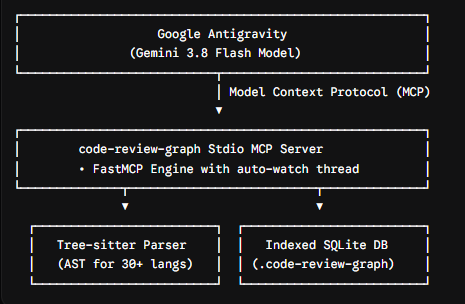
Why SQLite + Tree-sitter Wins:
- 80x Token Savings: Instead of dumping 150 KB of raw code into context to find a caller, Antigravity executes
query_graph_toolorget_impact_radius_tool. It receives 2 KB of structured, 100% accurate caller metadata. - Instant Blast-Radius Analysis: Modifying a core function? One tool call tells the agent exactly which 4 functions in 3 files depend on it.
- Disk-Backed Scalability: Because the graph lives in a compact SQLite file on disk (
.code-review-graph/graph.db), it scales to multi-hundred-thousand-line monorepos without consuming gigabytes of system RAM.
🛡️ The 3 Pillars of the “Make Gemini Flash Better” System
Our open-source setup configures three complementary layers inside Antigravity:
Pillar 1: The Laziness Ladder & Quality Rules (GEMINI.md / AGENTS.md)
We created a strict set of behavioral rules that force the agent to act like the laziest senior engineer:
- Never delete existing code: Unless explicitly told to remove a specific function, existing code must remain untouched.
- Minimal, surgical edits only: Rewrite only the exact changed lines. Whole-file regenerations are banned.
- The Laziness Ladder: Before writing new code, check: Does it already exist? Does the standard library do it? Can a native platform feature (like HTML
<dialog>or CSS Grid) replace an external library? - Graph-First Navigation: Mandates that the agent queries the code knowledge graph before executing naive text scans.
Pillar 2: Silent Background Automation (hooks.json + PowerShell)
You shouldn’t have to manually build an index every time you start coding. We leveraged Antigravity’s Lifecycle Hooks:
SessionStartHook: Every time you open any project in Antigravity, a background script (auto-graph-build.ps1) checks for source code. If the project hasn’t been indexed, it kicks offcode-review-graph buildsilently in the background.PreInvocationHook: Right before Gemini Flash generates a response, an ephemeral reminder reinforces the rules: Read before write, make minimal edits, and run tests.
Pillar 3: Continuous Watcher (mcp_config.json)
The MCP server is registered with the --auto-watch flag. Using the watchdog library, any file you or the agent save triggers an incremental delta update in milliseconds. The graph is never out of sync.
📊 Real-World Results
After rolling out this setup across our production projects, the difference was night and day:
| Metric | Stock Gemini Flash | With Our System |
|---|---|---|
| Transitive Caller Accuracy | ~65% (hallucinates indirect calls) | 100% Deterministic |
| Context Overhead per Query | 40,000 – 120,000 tokens | 500 – 2,000 tokens |
| Accidental Code Wipe Incidents | Frequent on multi-file refactors | Zero |
| Refactoring Blast-Radius Latency | 30–60 seconds (10+ greps) | < 1.5 seconds |
🚀 How to Set This Up in 60 Seconds
We bundled the entire configuration—package installation, MCP server, hooks, scripts, and rules—into a single, zero-friction setup prompt.
Quick Start:
- Head over to our GitHub repository: aloysiuspattath/make_gemini_flash_better
- Open
PROMPT.mdand click Copy raw contents. - Paste the entire message into your Google Antigravity chat.
Antigravity will install the dependencies, register the global MCP server, wire up the background hooks, and verify everything automatically. From that point forward, every project you open in Antigravity will be automatically indexed, guarded, and optimized.
🙏 Credits & Acknowledgements
This setup is made possible thanks to incredible open-source innovations:
- code-review-graph by Tirth Patel for the SQLite Tree-sitter knowledge graph engine.
- GitNexus by Abhigyan Patwari and Graphify for pioneering code intelligence knowledge graph concepts.
- Model Context Protocol (MCP) by Anthropic and the Linux Foundation.
- Google DeepMind for Google Antigravity and the Gemini 3.8 Flash series.
Enjoying this setup or have ideas to improve it? Star the repo on GitHub: github.com/aloysiuspattath/make_gemini_flash_better and share your thoughts in the comments on insanertech.com!